Search Results for: china

National Geographic January 1947

By Eric

What I Saw Across the Rhine
J. Frank Dobie traveled for several months in the U. S. zone of occupied Germany after the war. He paints a picture of a country in defeat – – impoverished, sullen, and gray.
Canada’s Caribou Eskimos
The Padlermiut, or Caribou Eskimos ( Inuit) , are the only Eskimos tribe without a sea culture. Outside contact means that today they depend on traders as much as they depended on caribou.
Adventures in Lololand
Rumors of captured American servicemen enslaved by the Lolos of southwestern China, prompt Rennold L. Lowy to join a rescue party.
Sponge Fishermen of Tarpon Springs
Jennie E. Harris visits a community of Greek immigrants in Florida to learn about the underwater world of sponge divers.
Cuba- -American Sugar Bowl
Between the departure of the Spanish and the arrival of the communists, Cuba was a favorite destination for vacationing Americans. In addition to tourism, the Pearl of the Antilles was best known for the export of sugar and tobacco.
National Geographic March 1948

By Eric

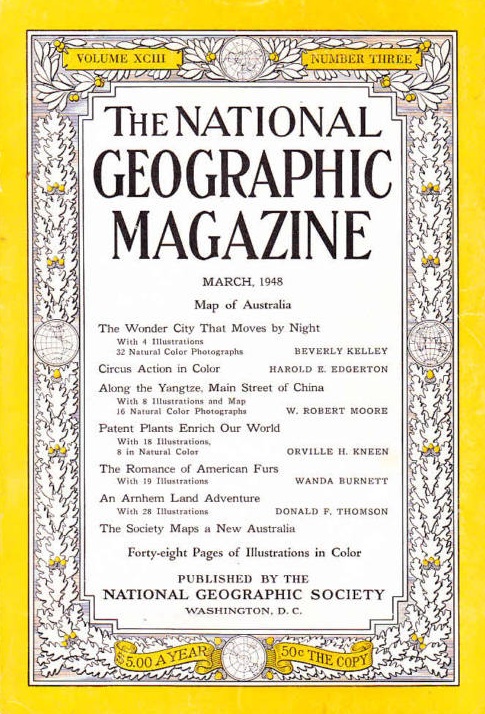
The Wonder City That Moves by Night
The Ringling Bros. and Barnum & Bailey Circus, the Greatest Show on Earth, can pick up and move across town or county, thanks to its own organized and crafty people.
The Romance of American Furs
In 1947, U. S. retail fur dealers sold over 450 million dollars worth of furs. Learn where the fashion industry gets the pelts and how the coats are made.
Along the Yangtze, Main Street of China
Follow the Yangtze River for 1, 500 miles from Chungking to Shanghai, and brave spectacular gorges and seething rapids.
An Arnhem Land Adventure
The Aborigines of Arnhem Land in northern Australia have persistently dared defend their way of life against the incursions of the white man.
Patent Plants Enrich Our World
The Plant Patent Act of 1930 enabled botanists and growers to patent specific plants and their offspring. Over 750 different plants have been patented and about half of them are roses, reports Orville H. Kneen.

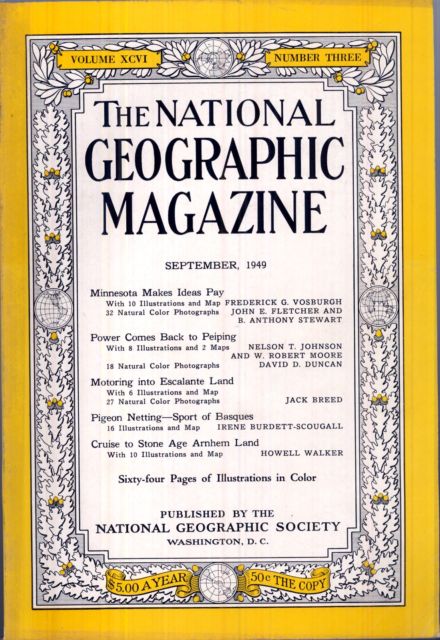
National Geographic September 1949

By Eric

Pigeon Netting- -Sport of Basques
A photo- essay highlights the autumn Basque sport of snaring migrating wood pigeons.
Power Comes Back to Peiping
For over 3, 000 years, the city of Peiping ( Beijing) has been a seat of power in China. Following tradition, communist rulers decide to return the government’s capital from Nanking ( Nanjing) to Peiping.
Cruise to Stone Age Arnhem Land
On a voyage to deliver food and supplies to the Arnhem Expedition in northern Australia, the Phoenix runs aground in isolated Boucat Bay and affords her crew an opportunity to get to know aborigines and local missionaries.
Minnesota Makes Ideas Pay
Riding the wave of the postwar boom, Minnesota aims to be in the forefront of intellectual and scientific achievement.
First Motor Sortie into Escalante Land
A joint expedition of the National Geographic Society and the New York Explorers Club is the first to venture by all- wheel- drive into the Escalante wilderness, south of Bryce Canyon National Park.

National Geographic April 1937

By Eric

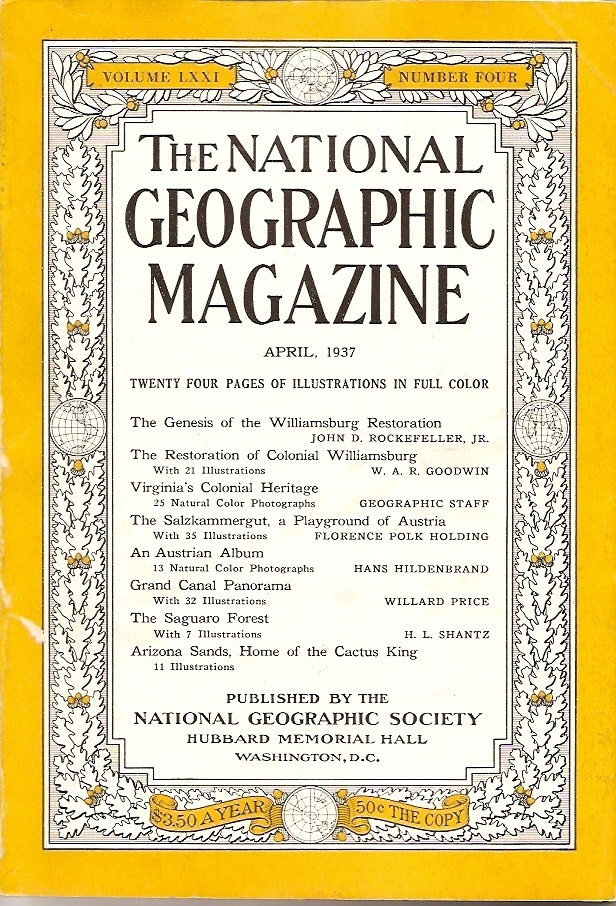
Grand Canal Panorama
A voyage on the nearly 2, 500- year- old Grand Canal reveals the real heart of China.
The Restoration of Colonial Williamsburg
Williamsburg, Virginia, named the capital of colonial Virginia in 1699, was carefully restored over the course of more than nine years so that the future may learn from the past.
The Salzkammergut, a Playground of Austria
A paradise of mountains, valleys and lakes often called the Switzerland of Austria, the area surrounding the beautiful city of Salzburg heartily celebrates various festivals.
The Saguaro Forest
East of Tucson, Arizona, peculiar giant saguaro forests thrive, havens for gila monsters, owls, coyotes, bobcats, and quail.
The Genesis of the Williamsburg Restoration
John D. Rockefeller, Jr. , who contributed funds to the restoration of Versailles, Fontainebleau and Reims, explains why he chose to fund the restoration of the colonial town of Williamsburg, Virginia.

National Geographic December 1937

By Eric

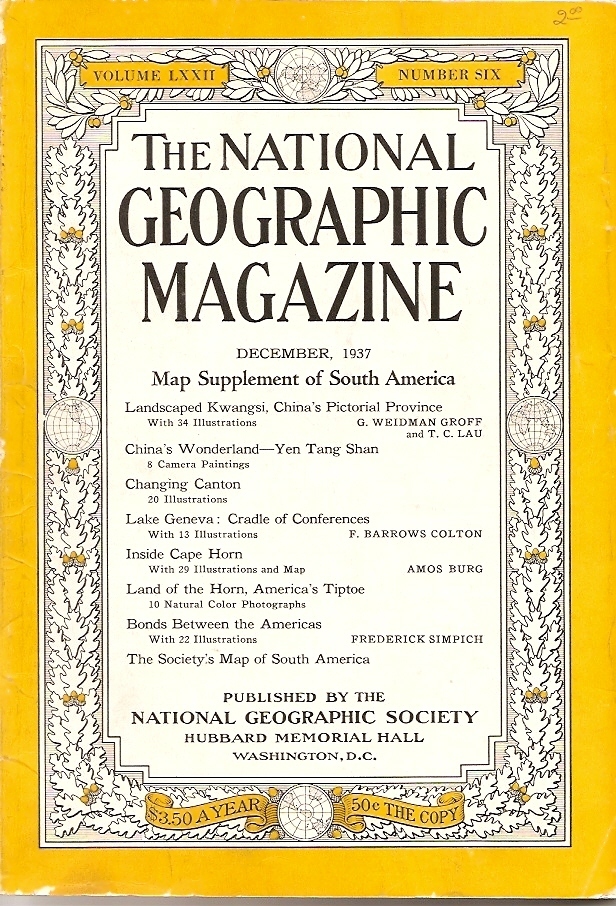
Inside Cape Horn
Rounding South America’s Cape Horn in a 26- foot boat yields eight months of adventure, mishap, and triumph in a region of everlasting storms.
Landscaped Kwangsi, China’s Province of Pictorial Art
China’s naturally sculpted, rustic province of Kwangsi ( Guangxi) is the site of many spectacular rock formations.
Bonds Between the Americas
Intertwined in the American economy, South America exports cacao nitrates, coffee, rubber, and other raw materials to the United States.
Changing Canton
Though pagodas and pai- lous, or archways, still decorate the ancient Chinese city of Canton ( Guangzhou) , they are being overshadowed by modern buildings.
Lake Geneva: Cradle of Conferences
Switzerland’s Lake Geneva country, peace hub of the world, has hosted many international conferences and has learned to take crises in stride.

National Geographic March 1938

By Eric

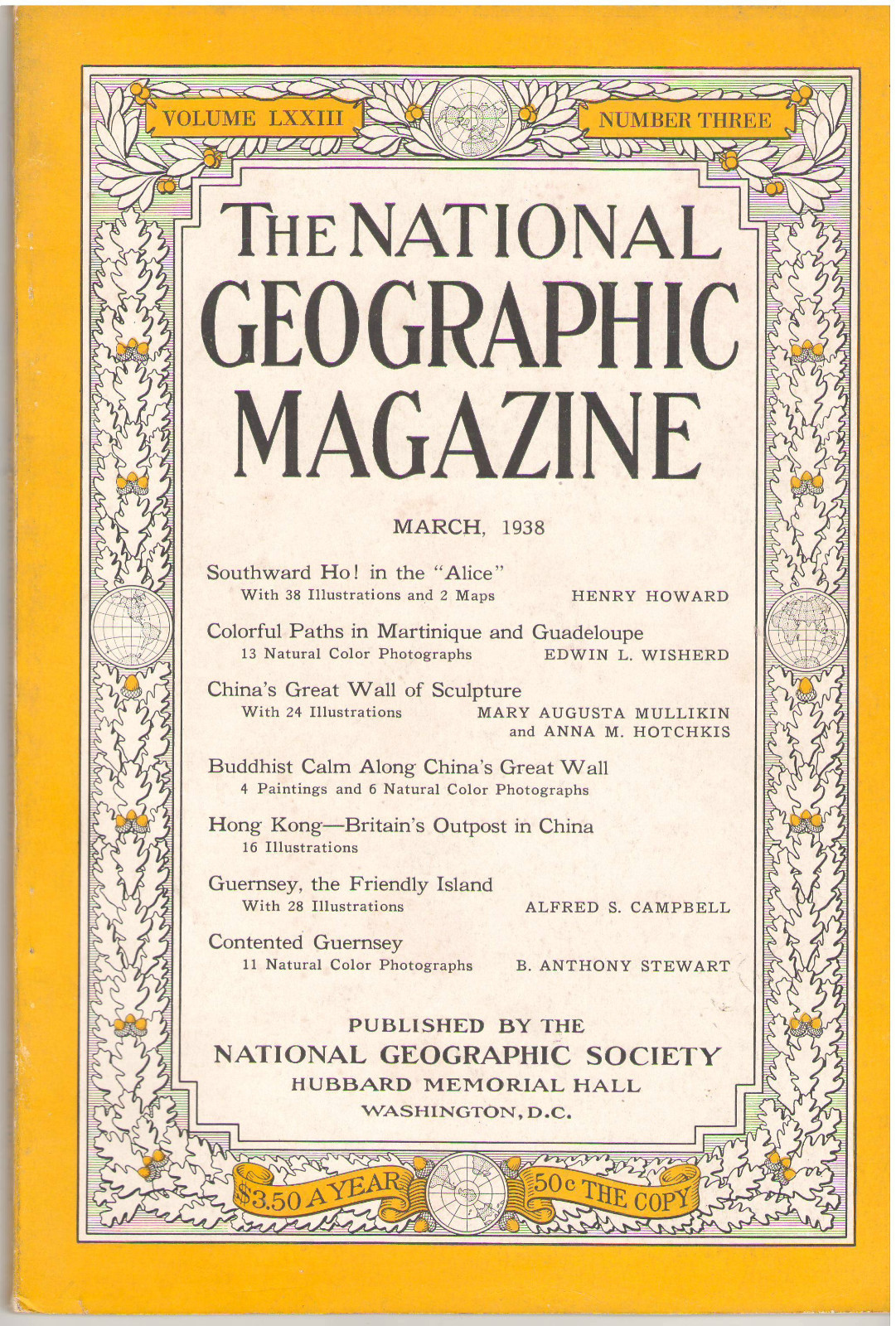
China’s Great Wall of Sculpture: Man- hewn Caves and Countless Images Form a Colossal Art Wonder of Early Buddhism
The caves at Yun Kang, in China’s Shansi ( Shanxi) Province, stretch for more than a mile and are decorated with paintings and ornate Buddhist images carved from sandstone by the Toba Tatars of the Northern Wei dynasty, who ruled northern China from A.
Southward Ho! In the Alice
Following the path of pirates in a 52- foot sailboat, the Alice, eight seafarers leisurely cruise from North Carolina to the West Indies, finding friendly Caribbean residents instead of buried treasure.
Hong Kong- -Britain’s Outpost in China { Hong Kong- -Britain’s Far- flung Outpost in China}
Photographs reveal that Hong Kong, owned by Britain, is a cosmopolitan port city.
Guernsey, the Friendly Island
Living amid quaint streets, prim gardens, and cattle farms, the residents of the British island of Guernsey speak both French and English.