Search Results for: space

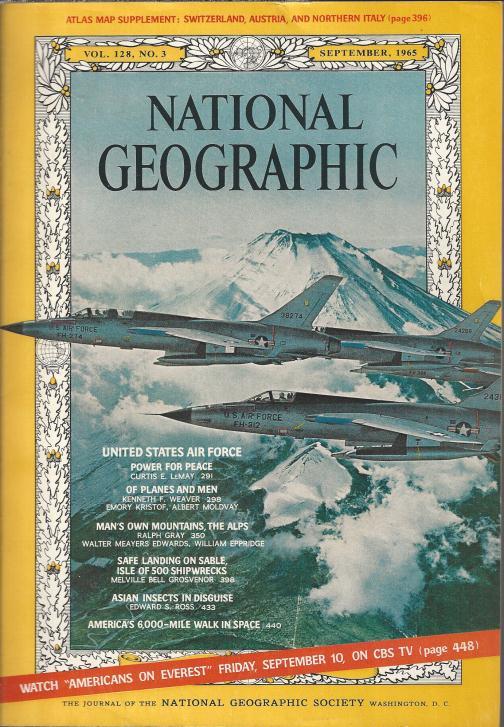
National Geographic September 1965

By Eric

1898: The Bells on Sable
Mr. and Mrs. Alexander Graham Bell visit Sable Island and search for the bodies of friends lost in a shipwreck.
America’s 6, 000- mile Walk in Space
NASA’s manned flight program brings back dramatic photographs of Maj. Edward H. White II, orbiting at 17, 500 miles per hour. Tethered to Gemini 4, he made a 21- minute sortie, the longest space walk to date.
Asian Insects in Disguise
Curator of entomology at the California Academy of Sciences photographs and describes remarkable insects that mimic plants in Southeast Asia.
Man’s Own Mountains, the Alps { The Alps: Man’s Own Mountains}
A staff member takes his family on a summer ramble to understand the geology, history, and human uses of Europe’s famous range.
National Geographic’s Newest Adventure: a Color Television Series
The Society’s President and Editor announces four inaugural films to be broadcast during the 1965- 66 television season, starting with Americans on Everest.
U. S. Air Force: Power for Peace
A proponent of peace through military strength, a former U. S. Air Force Chief of Staff ( 1961- 65) and Society trustee, recalls personal experiences that illustrate changes in the Air Force during his lifetime.
Of Planes and Men: U. S. Air Force Wages Cold War and Hot
Staff writer and photographers participate in wartime missions in Vietnam to understand the variety of combat readiness of the U. S. Air Force. Visiting bases in 20 states and nine foreign countries, they report on missiles, planes, and orbiting laborato
Safe Landing on Sable, Isle of 500 Shipwrecks
The Society’s President and Editor sails his yawl to the island off Nova Scotia where the Labrador Current meets the Gulf Stream, and recalls stories told by his grandfather Alexander Graham Bell.
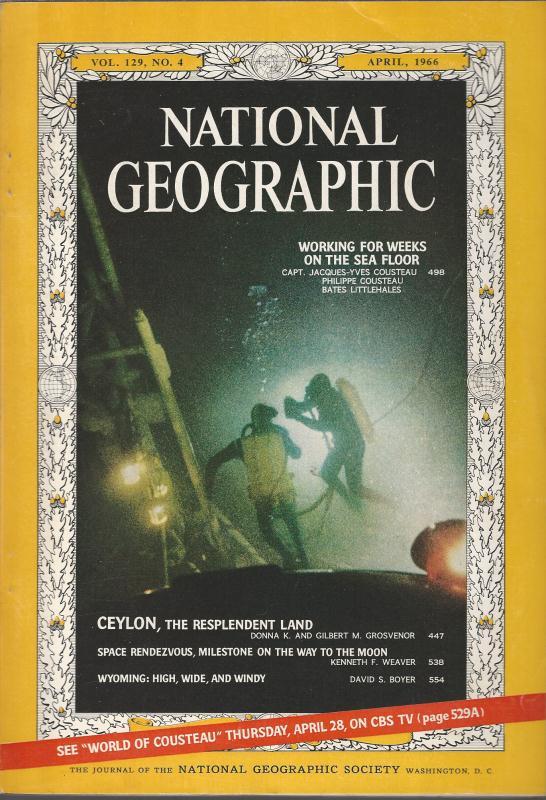
National Geographic April 1966

By Eric

Ceylon, the Resplendent Land { Ceylon}
In the colorful island nation off India, a Sinhalese majority practices Buddhism beside Hindu Tamils and a smattering of Christians and Muslims.
Space Rendezvous, Milestone on the Way to the Moon
In the first meeting ever of manned spacecraft, pilots of Gemini 6 and Gemini 7 come within a foot of docking, a step on the reach for the moon.
Working for Weeks on the Sea Floor
A house- workshop called Conshelf Three shelters six oceanauts exploring the Mediterranean seafloor 370 feet below the surface.
Wyoming: High, Wide, and Windy
One of the largest states, with one of the smallest populations, bears the look of the Old West but ranks as a major mineral producer.

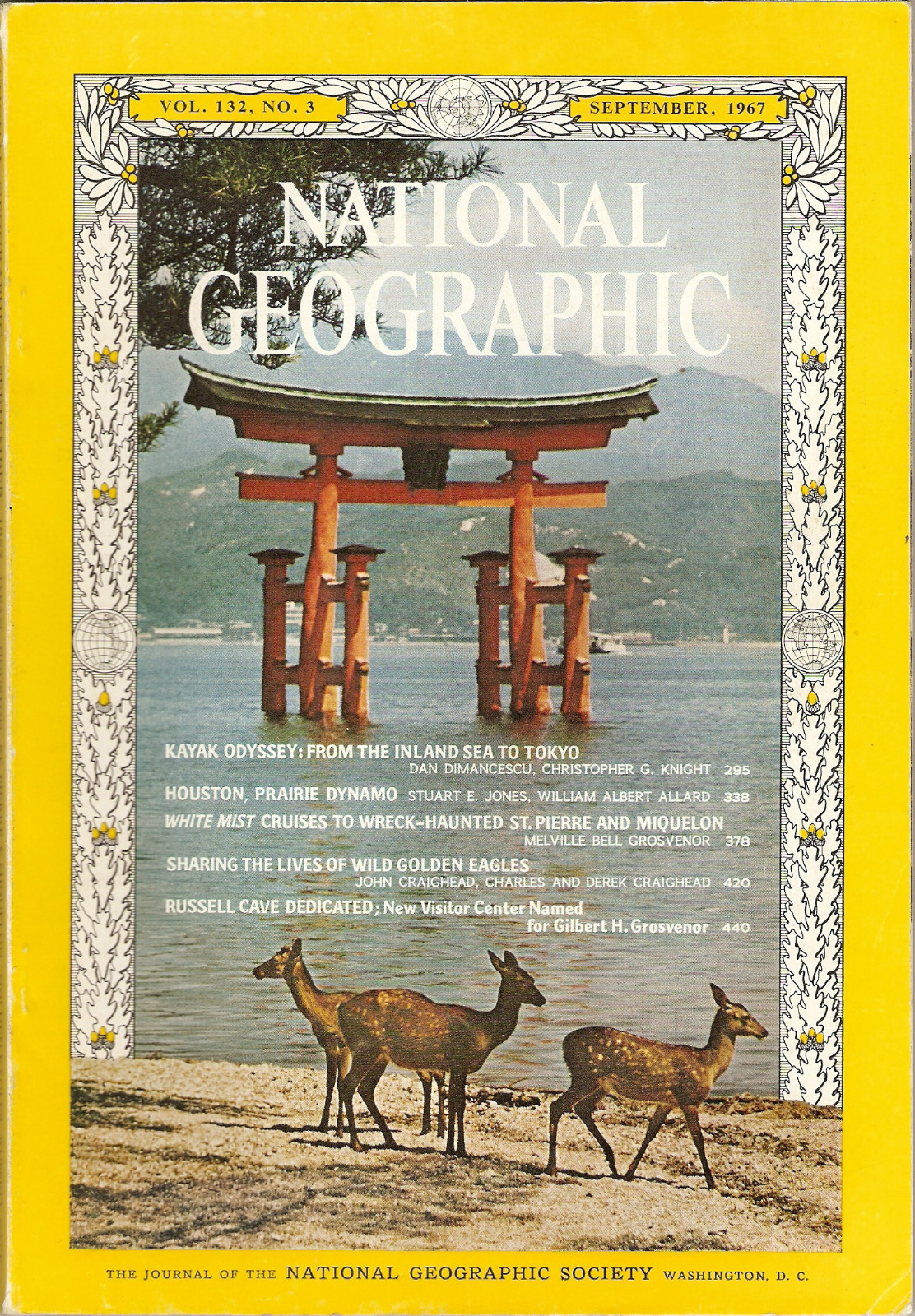
National Geographic September 1967

By Eric

Kayak Odyssey: From the Inland Sea to Tokyo
Traveling by kayak on a 1, 100- mile journey, American and British youths meet the Japanese of remote villages bordering Japan’s Inland Sea.
Sharing the Lives of Wild Golden Eagles
Near Livingston, Montana, researchers climb windy crags to observe the courtship, nesting, and hunting habits of the magnificent raptors whose habitat is shrinking around the world.
[ White Mist] Cruises to Wreck- haunted St. Pierre and Miquelon
In his yawl, White Mist, the Geographic’s Editor and his crew investigate islands off Newfoundland that are French to their core.
Houston, Prairie Dynamo
The nation’s sixth largest city and third largest port rounds off the brash edges of a western town with a newly minted affection for art, astrodome, and space center.
Russell Cave Dedicated; New Visitor Center Named for Gilbert H. Grosvenor
Named for the Society’s late President and Editor, a new national monument protects an Alabama cavern that sheltered primitive hunters almost 9, 000 years ago.

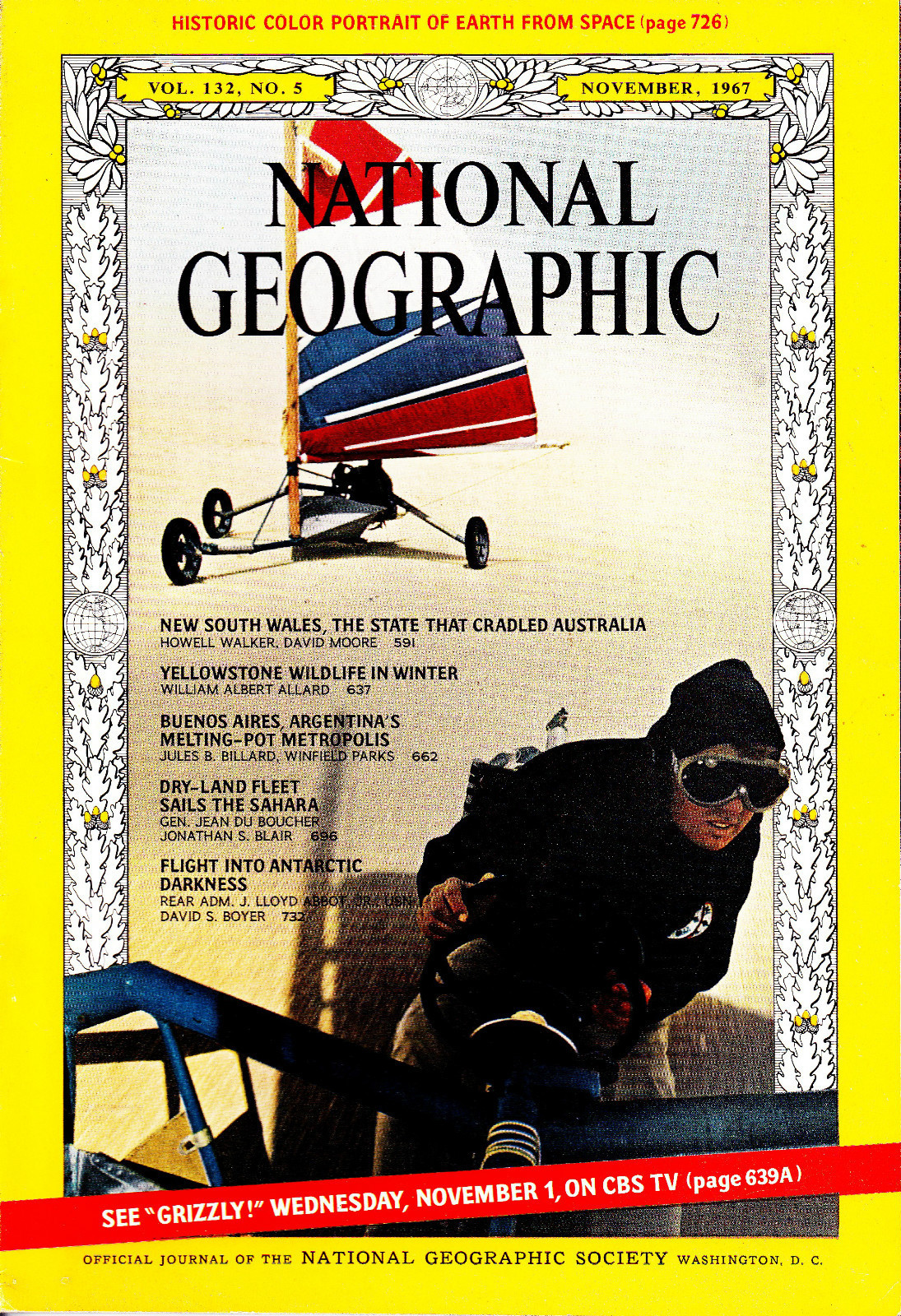
National Geographic November 1967

By Eric

Yellowstone Wildlife in Winter
When most tourists have gone home, the National Park Service conducts studies and population control on buffalo, elk, and bighorn sheep in the solitary snow- mantled beauty of a Yellowstone winter.
Flight Into Antarctic Darkness
Navy airmen inaugurate regular flights by ski- equipped C- 130s from New Zealand to supply researchers at McMurdo Station.
Buenos Aires, Argentina’s Melting- pot Metropolis
Europeans of every nationality and their descendants look for the good life in South America’s largest urban area.
New South Wales, the State That Cradled Australia
Australia’s most populous state, with the federal capital in Sydney, swells with immigrants seeking work in expanding factories.
Dry- Land Fleet Sails the Sahara
Driven by bright sails, 12 one- man vehicles challenge the rocky wasteland from Bechar, Algeria, to Nouakchott, Mauritania, on a month- long journey that delights desert- dwelling observers.
Historic Color Portrait of Earth From Space
A U. S. Department of Defense spacecraft named Dodge photographs Earth from 21, 000 miles out, making the first such pictures of our home planet.

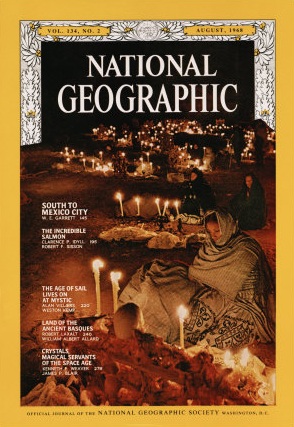
National Geographic August 1968

By Eric

Land of the Ancient Basques
An American born of Basque parents explores the western Pyrenees on the France- Spain border, land of his forefathers.
The Age of Sail Lives On at Mystic
The author, also a sailor, finds special pleasure in Mystic Seaport, Connecticut, a living maritime museum that preserves square- riggers, schooners, and heirlooms from the age of sail.
The Incredible Salmon
Among the world’s great voyagers, salmon crisscross the Pacific but return to home rivers in the Pacific Northwest to spawn and die.
Crystals, Magical Servants of the Space Age
Synthetic crystals lie at the heart of modern technology, from solar cells for satellites to the ruby rod of the laser.
South to Mexico City
Heading from the U. S. to the site of the 1968 Olympic Games, the author and his family drive to out- of- the- way sights in Mexico, often referring to accounts of early Indian empires described by 16th- century conquistadores.

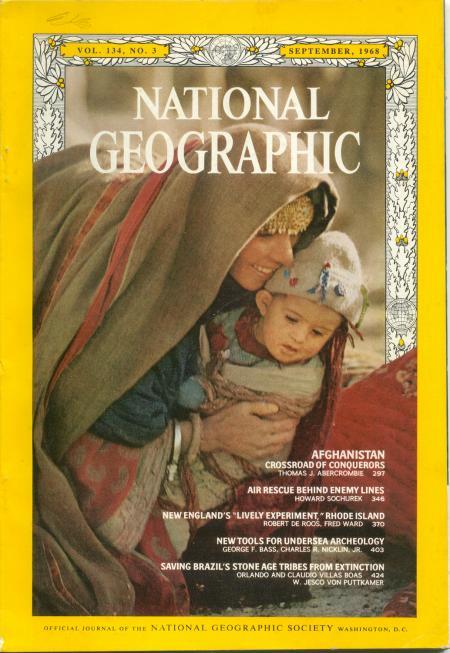
National Geographic September 1968

By Eric

Afghanistan: Crossroad of Conquerors
A staff writer joins Tajik horsemen in buz kashi, a rough game that reflects the fighting spirit of tribes dwelling in the landlocked crossroads of Central Asia.
Saving Brazil’s Stone Age Tribes From Extinction
Brazilian brothers administer Xingu National Park as a refuge for tribal peoples endangered by white miners and foreign diseases. Only a third of an estimated 3, 000 Indians survive.
New Tools for Undersea Archeology
A seasoned marine archaeologist describes the technology that permitted him to locate and excavate ancient wrecks, including a Byzantine and Roman ship, off southwest Turkey in the Aegean Sea.
New England’s Lively Experiment, Rhode Island
Taking a chance on religious liberty, the colony of Rhode Island was the first to declare independence from Great Britain. Now the smallest state boasts a highly industrialized economy.
Air Rescue Behind Enemy Lines
In acts of death- defying courage, the U. S. Air Force’s Aerospace Rescue and Recovery Service saves downed fliers in the Vietnam War.