Search Results for: space

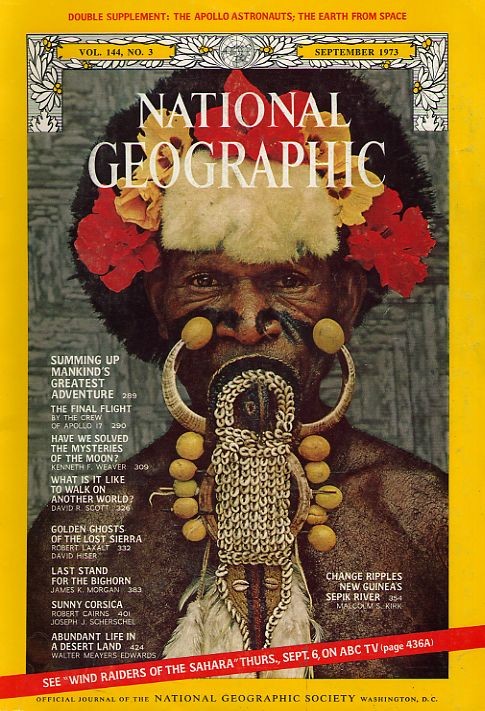
National Geographic September 1973

By Eric

Last Stand for the Bighorn
Remnant bands of Rocky Mountain bighorn sheep follow traditional migration routes between seasonal ranges along Idaho’s Salmon River.
Abundant Life in a Desert Land
Some 35 species of cactuses thrive in the Arizona preserve that takes its name from only one – – Organ Pipe Cactus National Monument.
Apollo Missions { What Is It Like to Walk on the Moon? }
The commander of Apollo 15 reflects on the three most memorable days of his life.
Apollo Missions { Have We Solved the Mysteries of the Moon? }
The answers to six questions about the moon sum up what we know and don’t know about Earth’s satellite.
Apollo Missions { Summing Up Mankind’s Greatest Adventure}
The Editor of NATIONAL GEOGRAPHIC reflects on the practical benefits and the meaning of the Apollo space program.
Apollo Missions { The Final Flight; Exploring Taurus- Littrow}
A crewmember of Apollo 17 reports on the experiences and findings of the final moon walks.
Change Ripples New Guinea’s Sepik River
On his third expedition to the interior, the author investigates the confusion created among New Guinea tribes by their increasing exposure to money culture.
Sunny Corsica: French Morsel in the Mediterranean
This mountainous Mediterranean island – – birthplace of Napoleon – – faced onslaught by world conquerors in the past. Now tourists invade.
Golden Ghosts of the Lost Sierra
Where forty- niners prospected for gold in a pocket of northeastern California, a handful of year- round residents relish the mountains and sometimes pan for gold.
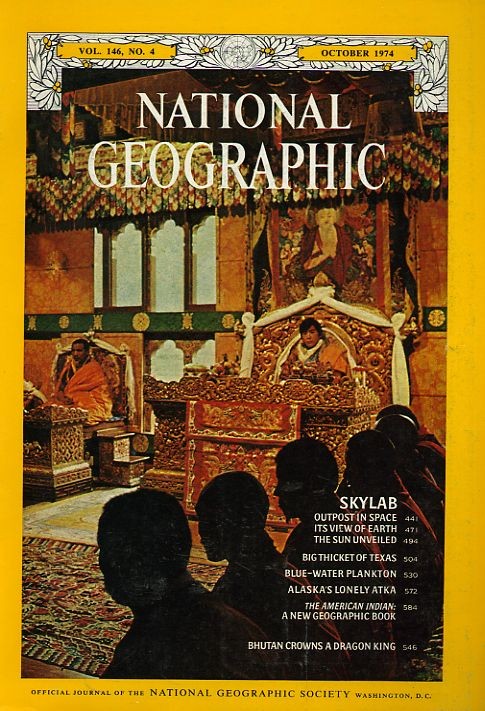
National Geographic October 1974

By Eric

Big Thicket of Texas
Early settlers cut through dense tangle to make homesites in the wild region northwest of Beaumont, now proposed for a national preserve.
Bhutan Crowns a New Dragon King
Surrounded by Buddhist ritual, an 18- year- old becomes the fourth hereditary king of the sequestered Himalayan nation.
Skylab { The Sun Unveiled; The Sun As Never Seen Before}
Skylab’s telescopes have observed the birth of a solar flare, storms, bright points, and coronal features.
Skylab { Skylab Looks at Earth}
The manned orbiting laboratory called Skylab carried multiple cameras and sensors that surveyed Earth’s crops, woodlands, and soil types, detected pollution, and studied clouds, sea, and snow cover.
Skylab { Skylab, Outpost on the Frontier of Space}
Skylab, America’s first manned orbiting laboratory, visited by three separate missions, has harvested a spectacular wealth of data to analyze.
Ghosts of the Gulf Stream: Blue- Water Plankton { Blue- Water Plankton: Ghosts of the Gulf Stream}
Scuba- diving researchers in Bahamian waters collect and count drifting organisms often too delicate to survive capture with nets.
Atka, Rugged Home of My Aleut Friends
On the far reaches of Alaska’s Aleutian Islands, families that long ago survived Russian slaughter and white man’s diseases battle poverty and isolation.

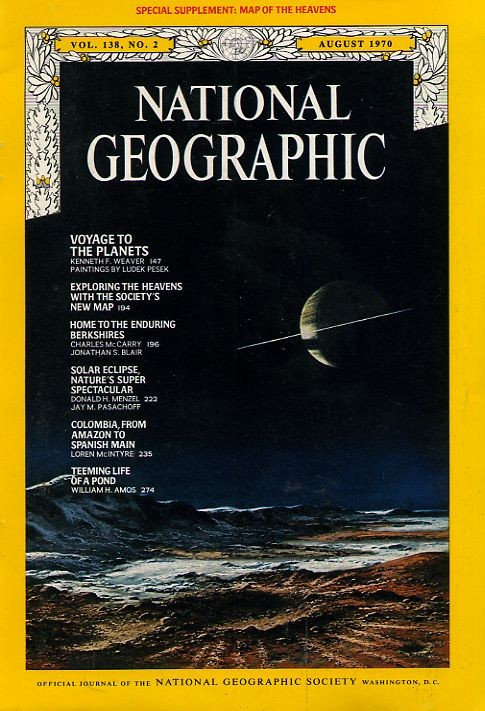
National Geographic August 1970

By Eric

Home to the Enduring Berkshires
A fifth- generation Berkshire man shares the wild beauty and history of the ancient hills rising between the New York State border and the Connecticut River of western Massachusetts.
Voyage to the Planets
With the knowledge gained from American and Soviet deep- space probes, the Geographic’s award- winning science writer and a Czech artist take an imaginary journey through our solar system and provide detailed descriptions of each planet.
Teeming Life of a Pond
A biologist photographs wildlife of Noxontown Pond, a damned marsh near Middletown, Delaware.
Solar Eclipse, Nature’s Super Spectacular
Astronomers report on an expedition to a village in southern Mexico where they recorded the dramatic alignment of a total eclipse.
From Amazon to Spanish Main: Colombia { Colombia, from Amazon to Spanish Main}
The economy of South America’s fourth largest nation encompasses modern textile mills, coffee plantations, traditional salt harvests, and the construction of a trans- Andean oil pipeline.

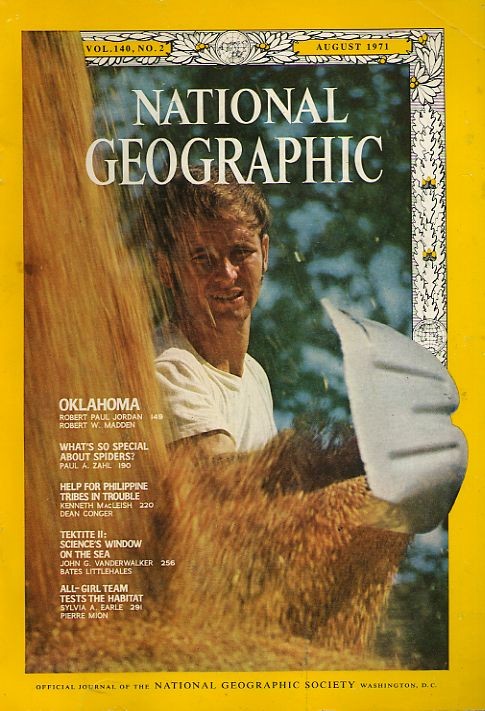
National Geographic August 1971

By Eric

Tektite II { All- Girl Team Tests the Habitat}
Five female scientists eat and sleep in the underwater habitat, Tektite II, while conducting scientific work underwater for 14 days.
Oklahoma, the Adventurous One
Where pioneers once trod, oil now flows. Residents of the 46th state transform their stubborn land into an agricultural and industrial giant, connected by rivers and channels to the sea.
Help for Philippine Tribes in Trouble
As settlers, miners, and lumbermen try to seize tribal lands in the highlands of Mindanao, the Philippine government acts to protect national minorities.
Tektite II { Science’s Window on the Sea}
Tektite II, an underwater habitat moored off St. John in the U. S. Virgin Islands, provides housing for divers who work at depth for 20 days at a time. Their dual mission: to survey the sea frontier and prepare for journeys into space.
What’s So Special About Spiders?
Feared and maligned, the world’s spiders destroy many times their number in insects and continue to fascinate scientists.

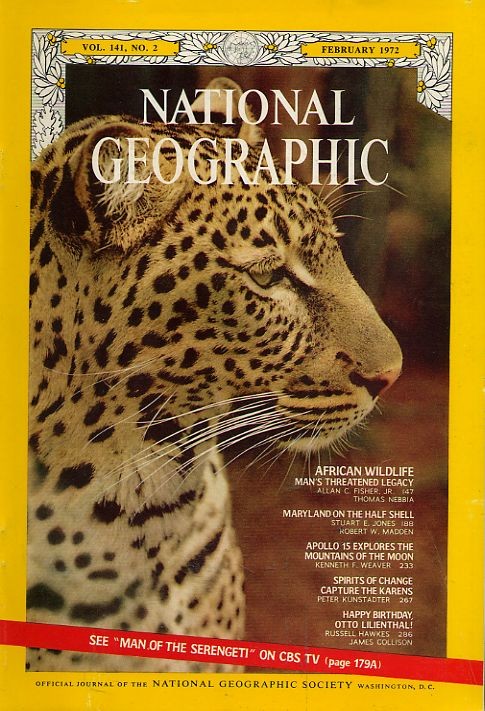
National Geographic February 1972

By Eric

Spirits of Change Capture the Karens
Tribesmen of western Thailand practice slash- and- burn and irrigated agriculture but make offering to the spirits to ensure their rice crops.
Maryland on the Half Shell
From the port of Baltimore to Camp David, Ocean City to Chesapeake Bay, this little state, one of the original 13, packs a wallop.
To the Mountains of the Moon { Apollo 15 Explores the Mountains of the Moon}
The most scientifically rewarding space voyage to date returns with 170 pounds of moon rocks collected by Apollo 15 astronauts traveling 17 miles across the moon’s surface.
Happy Birthday, Otto Lilienthal!
Young Californians revive the reputation of a German engineer whose glider flights inspired their home- built hang gliders.
African Wildlife: Man’s Threatened Legacy { Continent’s Living Treasure }
Hunters, poachers, herdsmen, and farmers have seriously reduced animal populations in Africa. Tanzania’s Serengeti National Park and Botswana protect the survivors.

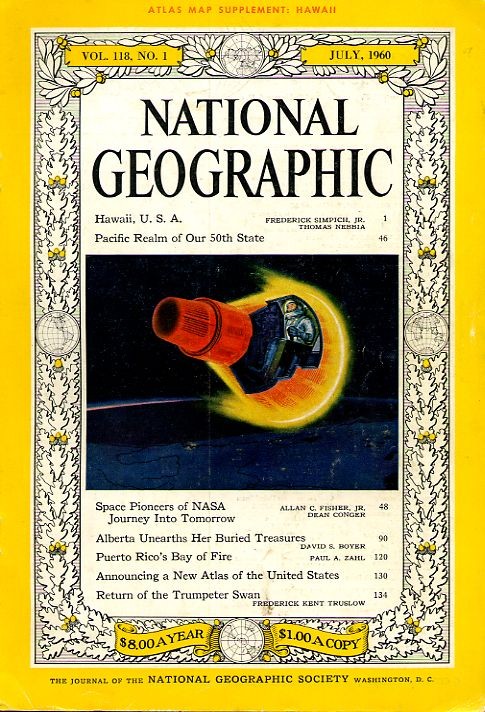
National Geographic July 1960

By Eric

Sailing a Sea of Fire
Large numbers of glowing microorganisms light the waters of a Puerto Rican bay.
Space Pioneers of NASA Journey Into Tomorrow { Exploring Tomorrow With the Space Agency}
Researchers and test pilots race the Soviets to send the first person into space.
Return of the Trumpeter
Nineteenth- century hunters nearly exterminated the world’s largest swan, but conservationists hope to stage a comeback.
Alberta Unearths Her Buried Treasures
David Boyer discovers the hospitality of this large Prairie Province.
Atlas of the Fifty United States
The Society presents its first book of bound and indexed maps.
Hawaii, U. S. A
Sugarcane and pineapples mean sweet success for this mid- ocean state born of volcanoes.