Search Results for: space

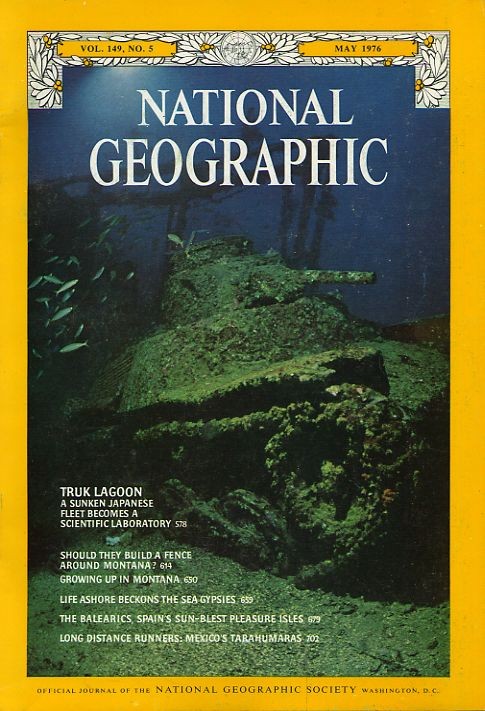
National Geographic July 1978

By Eric

Lake Erie Isles { Lake Erie’s Bass Islands; Yesterday Lingers on Lake Erie’s Bass Islands}
Good fishing, good wine, and a slice of Ohio’s yesterday enchant Terry and Lyntha Eiler.
Sailing With the Supertankers { Giants That Move the World’s Oil: Supertankers}
Awesome giants move the world’s oil, but each represents a potential disaster. Noel Grove and Martin Rogers report.
Is This the Tomb of Philip of Macedon? { Seeking the Tomb of Philip of Macedon; Regal Treasures From a Macedonian Tomb}
Greek archaeologist Manolis Andronicos finds exquisite paintings, gold caskets, and bones that could be those of the father of Alexander the Great. Photographs by Spyros Tsavdaroglou.
Black Day for Brittany { World’s Worst Spill; Superspill: Black Day for Brittany}
World’s biggest oil spill results when a tanker breaks apart on coastal rocks.
How Earth and Moon Look to a Space Voyager { Portrait of Planet Earth; Voyager’s Historic View of Earth and Moon}
En route to Jupiter, NASA’s Voyager 1 pictures our world and moon as never before.
Grand Canyon: Are We Loving It to Death?
A spectacular 14- page portfolio by Associate Editor W. E. Garrett captures the grandeur that draws three million visitors a year. But that same attraction poses a question. ..
Festival in Japan { Day of the Rice God: A Folk Festival in Rural Japan}
Drums and pipes herald a Japanese festival. Photos by H. Edward Kim; text by Douglas Lee.
Palau’s Dazzling Corals { Dazzling Corals of Palau}
Douglas Faulkner photographs a vast underwater garden in the Pacific that has become an environmental battleground. Text by Thomas O’ Neill.
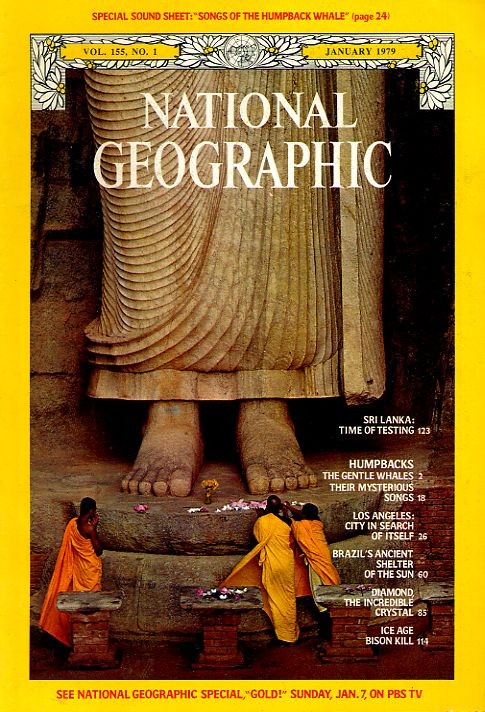
National Geographic January 1979

By Eric

Ice Age Bison Kill { Bison Kill By Ice Age Hunters}
Bones and spearpoints found in Colorado reveal how Paleo- Indians slaughtered huge buffalo by the hundreds. Anthropologist Dennis Stanford visualizes the ritual, and actually butchers a dead zoo elephant using stone tools.
Brazil’s Ancient Shelter of the Sun { Stone Age Past and Present Meet in Brazil; Man in the Amazon: Stone Age Present Meets Stone Age Past}
Primitive Amazonian Indians help unearth a shelter where their forebears may have worshipped the sun at least 9, 000 years ago. W. Jesco von Puttkamer documents one of the oldest human sites yet found in South America.
Time of Testing for Sri Lanka { Sri Lanka: Time of Testing for an Ancient Land}
The Resplendent Land, long known as Ceylon, pushes ambitious plans for critically needed new jobs and farmlands. Story by Robert Paul Jordan, with photographs by Raghubir Singh.
Los Angeles: City in Search of Itself
The era of freewheeling sprawl, smog, and show biz runs into a space problem, and a flood of Spanish- speaking newcomers brings a new flavor. William S. Ellis and Jodi Cobb explore what’s happening in our third largest metropolis.
Humpback Whales { Humpbacks: The Gentle Whales; Humpbacks: The Gentle Giants}
Marine biologist Sylvia A. Earle and photographer Al Giddings swim confidently among those benign behemoths off Hawaii and Alaska.
Diamond, the Incredible Crystal { The Incredible World of Diamonds; The Incredible Crystal: Diamonds}
Why is the hardest of substances ever more precious to man? Fred Ward visits mines, cutting rooms, dealers, and buyers on four continents to assess that fabulous crystal.
Humpback Whales { Humpbacks: Their Mysterious Songs}
A unique recording brings the haunting sounds of the Humpback whale to life.

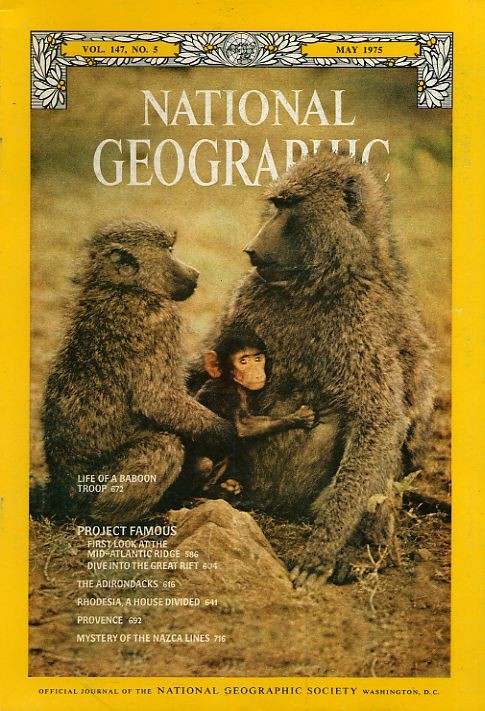
National Geographic May 1975

By Eric

Life with the Pumphouse Gang : New Insights Into Baboon Behavior
Among wild baboons in Kenya, females hold the troop together, reports a young U. S. anthropologist, Shirley C. Strum. Photographs by Timothy W. Ransom.
Mystery of the Ancient Nazca Lines
What impelled ancient Peruvians to lay out huge figures on the desert, visible only from the sky? Loren McIntyre turns his camera on the strange designs.
Rhodesia, a House Divided
Allan C. Fisher, Jr. , and Thomas Nebbia look thoughtfully at that lovely but politically troubled African land.
Provence, Empire of the Sun
France’s south lures author William Davenport with its quiet, independent backcountry life. Pictures by James A. Sugar.
Project FAMOUS- -Man’s First Voyages Down to the Mid- Atlantic Ridge { Dive Into the Great Rift}
The French- American Mid- Ocean Undersea Study sends scientists two miles down to the Mid- Atlantic Ridge. U. S. leader James R. Heirtzler defines its fissured, lava- shaped central valley. Geologist Robert D. Ballard takes you into the rift. Photographs
Project FAMOUS- -Man’s First Voyages Down to the Mid- Atlantic Ridge { Where the Earth Turns Inside Out}
In the oceanographic equivalent of the space program, scientists launch a great adventure in exploration, the first manned probe of the awesome Mid- Atlantic Ridge.
My Backyard, the Adirondacks
Ecologist Anne LaBastille tells why she lives in a remote cabin in the largest chunk of wilderness left in the eastern United States. Pictures by David Alan Harvey.

National Geographic June 1975

By Eric

New Life for the Troubled Suez Canal
Dredges, cranes, and minesweeping helicopters help reopen one of the world’s crucial ship channels. William Graves and Jonathan Blair report on Egypt’s bold plan for the waterway.
Andalusia, the Spirit of Spain
In the homeland of brave bulls, foot- stamping flamenco, and plangent guitars, Howard La Fay and Joseph J. Scherschel capture the living image of old Spain.
Strange March of the Spiny Lobster
Why does a colony of crustaceans migrate, single file and usually southward? Florida marine biologists try to find out. By William F. Herrnkind, Rick Frehsee, and Bruce Mounier.
Our Last Great Wilderness { Preserving America’s Last Great Wilderness}
National parklands would double with proposed addition of 32 million acres of Alaska’s surpassingly beautiful wilds. A photographic portfolio, with text by David Jeffery.
Alaska: Rising Northern Star
Joseph Judge assesses the people, problems, and promise of a state come of age and seeking to apportion its vast natural bounty. Photographs by Bruce Dale.
Flight to Venus and Mercury { Mariner Unveils Venus and Mercury}
Seen only dimly through earthbound telescopes, our planet’s inner sisters reveal startling details to the television eyes of a spindly spacecraft. Science editor Kenneth F. Weaver describes the voyage of Mariner 10.

National Geographic February 1976

By Eric

Handclasp in Space: Apollo- Soyuz { Apollo- Soyuz: Handclasp in Space}
As historic finale to the Apollo era, U. S. astronauts and Soviet cosmonauts rendezvous 140 miles above the earth. Text by Thomas Y. Canby.
The Azores, Nine Islands in Search of a Future
Portugal’s mid- Atlantic archipelago, still living much in the past, hears growing clamor for autonomy or full independence. Don Moser and O. Louis Mazzatenta look at the isolated world of the Azoreans.
Siberia’s Empire Road, the River Ob
One of the world’s great river systems drains north to the Arctic on the Soviet Union’s frontier between Europe and Asia. Robert Paul Jordan and Dean Conger find energetic Siberiaks bringing their oil- rich region into the technological age.
Adrift on a Raft of Sargassum
Robert F. Sisson takes a naturalist’s camera into a realm of strange life amid a vast sea of floating weed.
Thomas Jefferson: Architect of Freedom { Architect of Freedom: Thomas Jefferson}
Designs for our basic liberties and a new nation, handsome buildings and ingenious gadgets flowed from the mind of our third President, a universal man. Mike W. Edwards and Linda Bartlett offer a Bicentennial salute.
Minnesota, Where Water Is the Magic Word
The American dream seems attainable in a lake- spangled state with room enough for progressive cities, bountiful farmland, and wilderness guarded as a treasure. David S. Boyer and David Brill report.

National Geographic May 1976

By Eric

Long Distance Runners: Mexico’s Tarahumaras { The Tarahumaras: Mexico’s Long Distance Runners}
James Norman and David Hiser explore the strange half- lost world of the Tarahumaras, whose idea of sport is to kick a wooden ball day and night, sometimes for as much as 200 miles.
Life Ashore Beckons the Sea Gypsies { Sea Gypsies of the Philippines: Life Ashore Beckons the Bajaus}
The boat- dwelling Bajaus have come to a momentous crossroads: give up their wandering ways or continue to live with scant education, medical care, or respect from settled neighbors. By Anne de Henning Singh and Raghubir Singh.
Spain’s Sun- blest Pleasure Isles
Over the centuries, the Balearics have survived one conquest after another. Ethel A. Starbird and James A. Sugar find them happily weathering one more assault: myriad holiday seekers, armed with dollars, pounds, francs, and marks.
Should They Build a Fence Around Montana?
Mike W. Edwards and Nicholas deVore III look at the land of big sky at a critical moment, when staggering riches beneath the surface must be weighed against a more subtle kind of wealth – – open space and the right to enjoy it.
A Sunken Japanese Fleet Becomes a Scientific Laboratory: Truk Lagoon { Life Springs From Death in Truk Lagoon}
World War II turned an idyllic Pacific harbor into a flaming hell when U. S. Navy bombers sank some 60 Japanese vessels. Studying this sunken fleet more than a quarter of a century later, biologist Sylvia A. Earle and photographer Al Giddings find a uniq