Search Results for: civil war

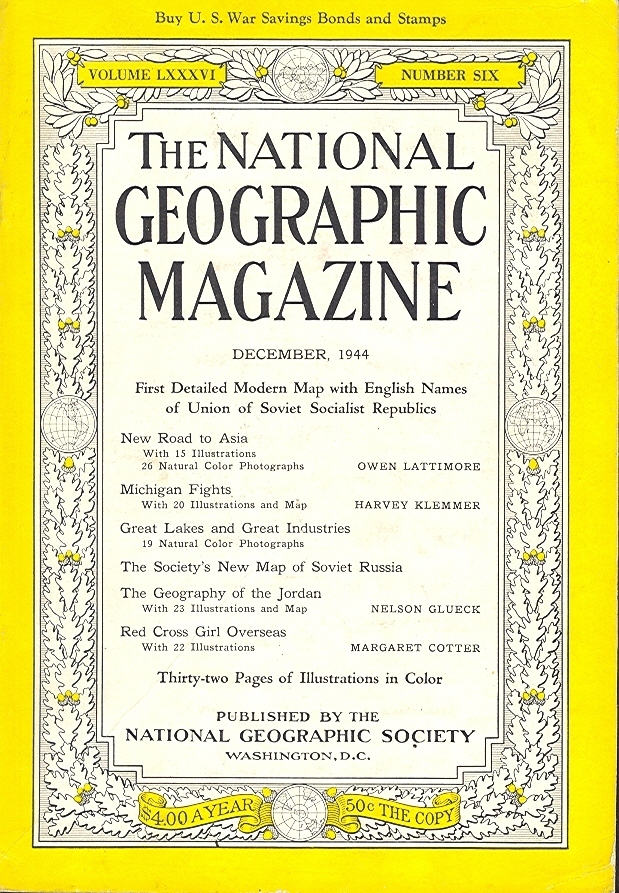
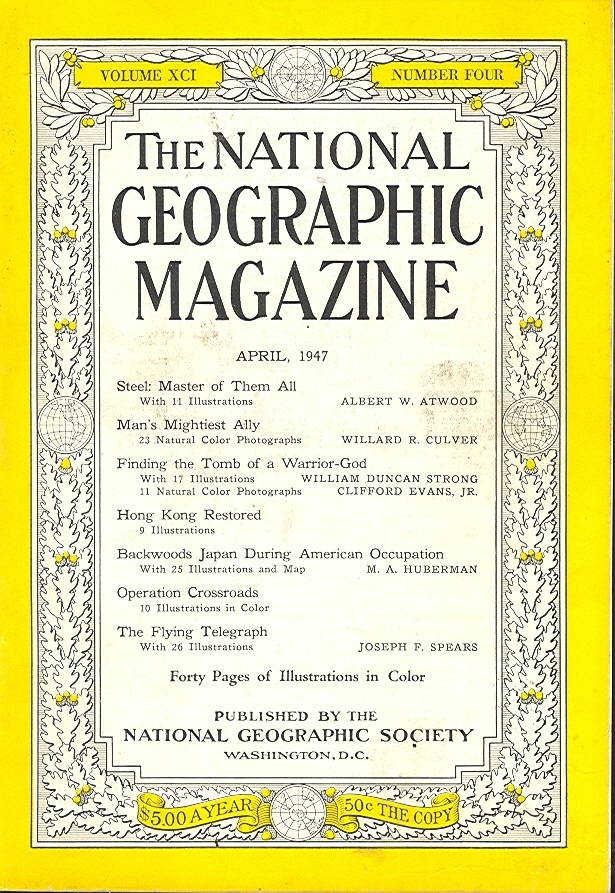
National Geographic April 1947

By Eric

Operation Crossroads
Eight Kodachromes and two paintings make up this photo essay of the U. S. atomic tests on Bikini Atoll ( Marshall Islands) .
Steel: Master of Them All
Albert W. Atwood describes the many products made from steel and the processes that go into creating them.
Finding the Tomb of a Warrior- God
The 1946 Columbia University Archeological Expedition to Peru explored the Viru Valley to discover the civilization of the Mochica people, and learn more about their brief but brilliant flowering.
The Flying Telegraph
In addition to radio, telephone, and telegraph, the U. S. Army in World War II also made use of one of the oldest means of long- distance communication: homing pigeons. These silent messengers are credited with saving thousands of lives.
Hong Kong Restored
A photo essay shows the renaissance of Hong Kong, restored to British rule after occupation by Japanese forces during World War II.
Backwoods Japan During American Occupation
An examination of the 60 to 65 percent of Japanese lands covered in forests, and interviews with their inhabitants, reveals their condition after World War II.

National Geographic January 1946

By Eric

England’s Wild Moorland Ponies
Each October, the wild ponies of Devon and Somerset are rounded up and auctioned at Bampton Fair. This annual event has taken place since the 13th- century reign of Henry III.
Earth’s Most Primitive People: A Journey with the Aborigines of Central Australia
A trip with the aboriginal inhabitants of the Australian outback shows them to be a tough and hardy people.
Nevada, Desert Treasure House
Vast mineral deposits, including gold and silver, are the foundation of Nevada’s economy and pioneering life style. The hard lives of the early miners, farmers, and cattlemen contrast with the glitter of Las Vegas, to create a portrait of the Sagebrush
Animals Were Allies, Too
An uncredited photo essay shows the animals’ part in the war effort. In addition to Doberman pinschers and German shepherds, horses, elephants, cattle, oxen, donkeys and mules, and even monkeys are shown making their contribution to the fight.
This Is My Own: How the United States Seems to a Citizen Soldier Back from Three Years Overseas
Home never looked so good. Frederick G. Vosburgh describes the sights, sounds, and emotions of GIs returning from the war.
Europe’s Looted Art
The U. S. Dept. of Defense is responsible for cataloguing art stolen by the Nazis, and when possible, returning it to the original owners.
Indians of the Southeastern United States
The complex cultures and political unions of southeastern Native American tribes are described, even though few traces of the ancient civilizations remain.

National Geographic June 1945

By Eric

Sights and Sounds of the Winged World: Study of Birds to Make NATIONAL GEOGRAPHIC Color Photographs Yields Rich Scientific Knowledge of Their Habits and Behavior
Discoveries in ornithology are described by Arthur A. Allen. Learn how owls see at night, if birds have a sense of smell, and how a hawk views the world.
China Fights Erosion with U. S. Aid
A group of soil scientists and specialists enlist in China’s fight against soil erosion. As thousands of refugees from the Japanese occupation stream into Free China, new methods of soil preservation and food production must be found.
Stilwell Road- -Land Route to China
The Stilwell Road links northern India and Yunan Province of China through Burma. The U. S. Army Corps of Engineers reopened the road in January 1945 after the Japanese retreat, despite massive challenges that threatened control of the vital route.
Tai Shan, Sacred Mountain of the East
Tai Shan is the most revered of the five sacred mountains of China. Even in wartime, pilgrims, vendors, and tourists ascend the 6, 700 steps, from the base to the Temple of the Jade Emperor, at its peak.
Americans Help Liberated Europe Live Again
As Europe repairs itself after World War II, the U. S. Army and military government work to ease the transition of newly freed countries back to civilian control.
The Society’s New Map of China
A new color map of China rounds out a complete set of maps released over a three- year period. This affords members complete coverage of the war against Japan.
George W. Hutchison
The Society pays tribute its Secretary, George W. Hutchison, who recently passed away.

National Geographic December 1944

By Eric

The Geography of the Jordan
Civilization along the Jordan River began about 10, 000 B. C. The Jordan River Valley is the site of many biblical stories and continues to be populated today.
New Road to Asia
The new Alaska- Siberia route is an air pathway that links America to Asia, introducing Americans to the people of Russia, including the Yakuts of Siberia.
Red Cross Girl Overseas
A woman in a group of 60 American Red Cross workers travels to Egypt to boost soldiers’ morale; she also glimpses the pyramids, rides an Arabian horse, flies a plane over the Nile Valley, lives in rugged tents, and survives an air raid.
The Society’s New Map of Soviet Russia
The National Geographic Society introduces and describes the first and only available modern map of the Soviet Union with place- names in English.
Michigan Fights
Michigan’s busy factories produce one- eighth of the weapons used in World War II, as well as engines, radios, ammunition, tanks, trucks, and planes.

National Geographic August 1942

By Eric

Busy Corner- -the Cape of Good Hope: Ships Bound for Faraway Battlegrounds Stream Past Capetown, Tavern of the Seas, and Other Ports of Virile South Africa
Because enemy troops obstruct the Mediterranean, all Allied war supply boats must pass South Africa’s mountainous Cape of Good Hope and stately Capetown.
Baja California Wakes Up
As Mexican and American troops work to defend Baja California from possible Japanese attack, the Seri Indians live placidly on this arid, 800- mile peninsula, fishing the rich Pacific waters.
Price of Free World Victory { The People’s Fight Against Slavery}
On May 8, 1942, United States Vice President Henry Wallace delivered this speech, which labels the current war as a fight between a slave world and a free world.
Blood, Toil, Tears, and Sweat : An American Tells the Story of Britain’s War Effort, Summed up in Prime Minister Churchill’s Unflinching Words
Fending off German troops with a stern will, British soldiers, pilots, factory workers, and civilians form one of the greatest military forces in the world.
Unknown Japan: A Portrait of the People Who Make Up One of the Two Most Fanatical Nations in the World
Though Japan studies American culture, the hardworking Japanese are an enigma to Americans, who struggle to understand their enemies in the Second World War.
The Pith of Peru: A Journey from Talara to Machu Picchu, with Memorable Stopovers
Crumbling Inca cities still stand in the high mountains of Peru, a country steeped in Spanish culture and Incan history.

National Geographic October 1941

By Eric

Daily Life in Ancient Egypt { Daily Life in Ancient Egypt ( Part I) }
As archaeologists unearth more Egyptian tombs, we gain a more comprehensive understanding of the Old and Middle Kingdoms of Egyptian civilization.
Peaks and Parks of Western Canada
As these photographs show, the Canadian Rockies are an unspoiled wilderness of high peaks, clear lakes, poppy fields, and abundant wildlife.
Daily Life in Ancient Egypt { Life, Culture, and History of the Egyptians; Daily Life in Ancient Egypt: [ The Later Period] ( Part II) }
The story of the final period of Egyptian civilization, the New Kingdom, unfolds with color illustrations that bring to life the people of ancient Egypt.
Rural Britain Carries On
War has touched the villages of rural England, yet the British people react to the bombings with resilience and optimism.